

If you work full-time, "study Finnish every day" can sound impossible. But 30 focused minutes a day is realistic, and it adds up to more than three hours a week. The key is to split the time between review, one new pattern, listening and active use, so that every session connects different skills. You do not need to cover everything; you need daily contact with Finnish that you can keep up for months.
A balanced 30-minute session
| Time | What to do |
|---|---|
| 10 min | Review words and old sentences |
| 5 min | One grammar pattern |
| 10 min | Listening |
| 5 min | Speaking or writing your own sentences |
Review comes first because it protects what you already learned. The last five minutes matter most: making your own sentences turns passive knowledge into Finnish you can use.
Fit it into a working day
You do not need one 30-minute block. Many busy learners split it:
- Morning commute (10 min): review words with audio.
- Lunch break (10 min): one short listening clip.
- Evening (10 min): one grammar pattern and five sentences about your day.
Attach each part to something you already do every day, such as coffee, the bus or brushing your teeth. Habits stick better than plans.
Make each day thematic
Choose one theme per session so the parts support each other. On a location-case day, review place words, practise kaupassa – kaupasta – kauppaan (in, from, to the shop), listen for missä, mistä, minne, then make five sentences about your own week.
A weekly rotation you can keep
- Monday: verbs and daily routines
- Tuesday: places, travel and location cases
- Wednesday: food, shopping and the partitive
- Thursday: spoken Finnish (mä oon, sä meet)
- Friday: the past tense: tell what you did this week
- Weekend: light review and real-life use: a shop, a neighbour, a Finnish show
Bring your job into it. If you work in care, a shop or an office, add the phrases you hear at work; see our Finnish workplace phrases.
One complete session around a real task
A shopping session: review kahvi, leipä, maito (coffee, bread, milk); practise Tarvitsen maitoa. – "I need milk"; listen to a short shopping dialogue; then say Missä maito on? – "Where is the milk?" One small task links vocabulary, grammar and real communication.
When 30 minutes is not possible
Keep a ten-minute minimum: review two old expressions, listen to one short message and say one new sentence. This is a fallback, not a replacement for longer sessions. Do not make up for a missed day by rushing through several new grammar topics.
Do not restart after a missed day
Just continue with the next session. Long-term consistency matters more than a perfect streak. Missing one day is normal; missing the habit for weeks is what slows progress.
Check what transfers to a new situation
At the end of the week, change the shopping task to a library task: Haluaisin lainata tämän kirjan. – "I would like to borrow this book." Which patterns can you reuse? Track abilities such as "I can ask for an item and understand a short answer", not only minutes studied. No timetable can promise a fixed date for fluency.
Quick practice
- What should the 30-minute plan include besides vocabulary?
- Should you restart the whole plan after missing one day?
- What makes a good study theme?
Answers
- Grammar, listening and active speaking or writing.
- No. Continue with the next session.
- A topic that connects vocabulary, grammar, listening and your own sentences.
For the full picture of how to learn Finnish, including what to study first, see our main guide.
How FinnSana helps
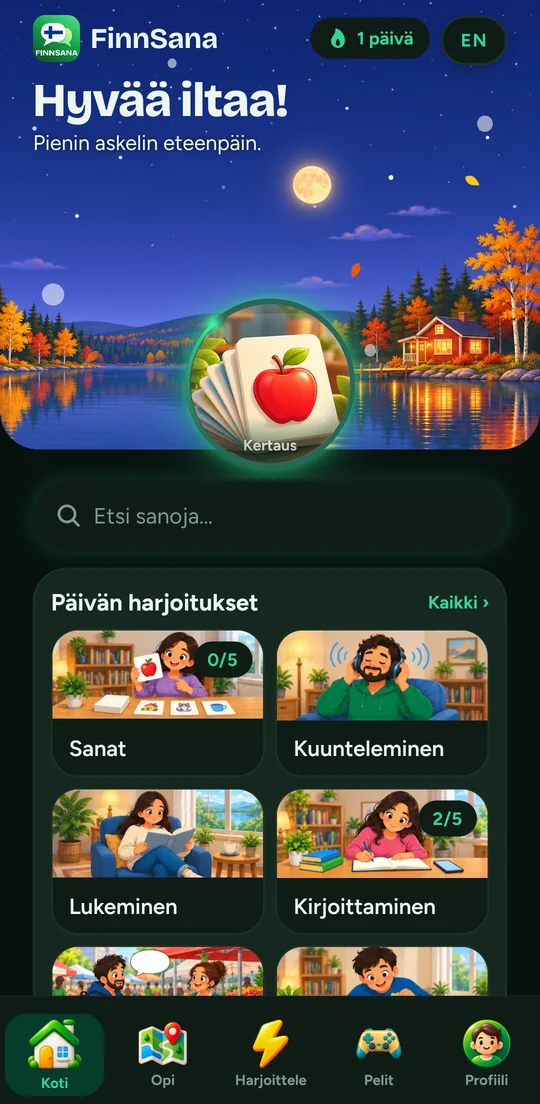
FinnSana has about 5,000 Finnish words with pictures, audio (normal or slow) and example sentences. Smart review brings words back before you forget them, and the big circle on Home leads you through each day step by step. The first chapters of every level are free.
See the FinnSana app · Get it on Google Play
Frequently asked questions
Is 30 minutes a day enough to learn Finnish?
It is enough to make steady progress, especially if you study every day and use Finnish in real life too. Reaching a working level still takes many months, so consistency matters more than intensity.
How can I learn Finnish while working full-time?
Split your study into short blocks attached to your routine, such as the commute and lunch break, and use your workplace as practice. Ten minutes three times a day is easier to keep than one long session.
What should I study first in a short daily session?
Start with review, then one small new pattern, a short listening clip and a few sentences of your own. Always finish by using the language actively.

 Topic guideHow to learn Finnish: a step-by-step plan from A1 to B1
 A2 & YKIFinnish A1 to A2: What to Learn Next
 BeginnerHow to Read Finnish Without Translating Every Word
 BeginnerCommon Finnish Beginner Mistakes (and How to Fix Them)
 Facebook
 Reddit
 LinkedIn
 WhatsApp