
You have finished A1: you can greet people, introduce yourself, ask simple questions and handle a few survival situations. Moving to A2 means relying less on memorised phrases and more on combining familiar words and grammar into your own sentences. You do not need advanced Finnish. You need more control over everyday Finnish, a past tense, and the confidence to say three sentences instead of one.
Step 1: Make A1 automatic
Before adding much new grammar, make sure these feel easy:
- present tense of common verbs (olen, menen, haluan)
- negatives and questions (en tiedä, puhutko …?)
- numbers, prices, times and dates
- common location forms (kaupassa, kauppaan, töissä)
- minulla on and everyday vocabulary
- simple requests (Saisinko …? Haluaisin …)
Our Finnish A1 goals page lists what this level covers.
Step 2: Add what unlocks A2
- The past tense: menin, olin, söin, so you can tell what happened.
- More partitive: after numbers, in negatives and with food and drink.
- Linking words: ja, mutta, koska, sitten.
- Spoken Finnish recognition: mä oon, sä meet, mulla on.
- Short messages: changing a time, confirming a meeting.
- Short conversations: two to five minutes about everyday topics.
Step 3: Make your answers longer
The clearest sign of progress is the size of your answers. At A1 you may say: Asun Hämeenlinnassa. Olen opiskelija.
Moving towards A2, you connect ideas: Asun Hämeenlinnassa ja opiskelen sairaanhoitajaksi. Eilen olin harjoittelussa sairaalassa. Työpäivä oli kiireinen, mutta opin paljon. – "I live in Hämeenlinna and I'm studying to become a nurse. Yesterday I was on placement at a hospital. The day was busy, but I learned a lot."
Notice what changed: ja and mutta join sentences, eilen and olin bring in the past, and there is a small opinion.
A practical week
- 30–50 useful words in sentences (fewer if recall becomes weak)
- two grammar patterns, practised in your own sentences
- short listening clips, repeated several times
- one short written text, such as a message or a diary entry
- one real or practice conversation
Three practical checks of your level
A2 is about handling familiar, routine situations. Try these:
- Shop: ask about a product and understand a simple reply.
- Message: write when and where you can meet. Model: En pääse tänään. Voimmeko tavata huomenna kello kaksi? – "I can't make it today. Can we meet tomorrow at two?"
- Story: describe yesterday in four or five understandable sentences.
If you can do all three without a script, you are well on the way. Skills often grow unevenly, so check listening, speaking and writing separately.
A2 is a communication goal, not a grammar list
The Council of Europe's description of A2 is about routine exchanges and simple descriptions of everyday needs. It is not an official list of Finnish grammar chapters or a fixed number of words. The topics here are suggestions for building those abilities. For an official level result, use an appropriate assessment or ask a teacher. Our Finnish A2 goals page shows what the next level looks like.
Quick practice
- Which tense should become familiar on the way to A2?
- Should A2 practice include spoken Finnish recognition?
- What should grow from A1 to A2: only grammar knowledge, or usable communication?
Answers
- The simple past (imperfect).
- Yes. Basic puhekieli recognition helps in real conversations.
- Usable communication.
How FinnSana helps
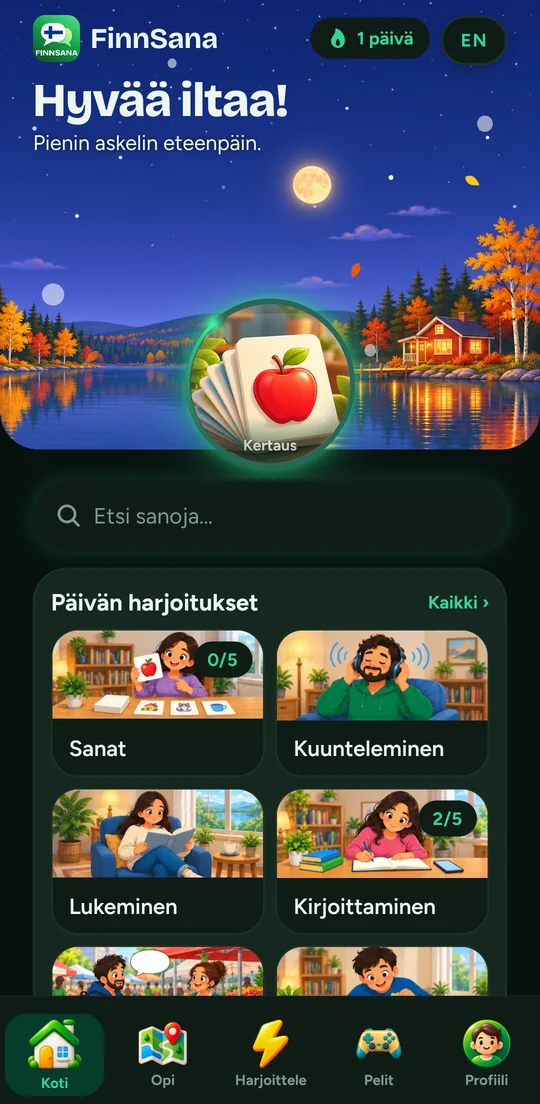
FinnSana has about 5,000 Finnish words with pictures, audio (normal or slow) and example sentences. Smart review brings words back before you forget them, and the big circle on Home leads you through each day step by step. The first chapters of every level are free.
See the FinnSana app · Get it on Google Play
Frequently asked questions
How long does it take to go from A1 to A2 in Finnish?
It varies a lot with how often you study and use Finnish. Regular daily practice plus real conversations usually moves you faster than occasional long sessions.
What grammar do I need for Finnish A2?
Typical A2 topics are the past tense, more partitive uses, location cases, the negative past and simple linking words. Use them to communicate, not just to fill in tables.
How do I know if I am at A2?
If you can handle routine situations, write short messages and describe your day in a few connected sentences, you are close. For an official result, take an appropriate test.

 Topic guideYKI test practice: how to prepare for all four parts
 Topic guideYKI practice on your phone: B1–B2 tasks in all four parts
 A2 & YKIFinnish A2 to B1: What to Practise Next
 A2 & YKIYKI Writing Practice: Messages and Revision
 A2 & YKIYKI Reading Practice: Find the Key Details
 Facebook
 Reddit
 LinkedIn
 WhatsApp