
Yes, it is realistic for an international nurse or nursing student in Finland to learn the Finnish needed on a ward, but it takes steady practice with both everyday Finnish and healthcare language. The biggest mistake is learning only grammar from a textbook. In nursing you also need to understand real patients, spoken Finnish, ward vocabulary, instructions, handovers and documentation.
How much Finnish do nurses need?
The level expected varies by employer, workplace and role. Hospital work usually needs strong communication, because nurses must understand patients, medication information, clinical instructions and handovers accurately. For language requirements, check the official licensing authority.
You do not need perfect Finnish before you start learning in clinical situations. What matters is that you communicate safely, understand important information and keep improving.
What to learn first
1. Everyday patient communication
Start with phrases you will use many times in every shift:
- Miten voit? – How are you feeling?
- Onko sinulla kipua? – Do you have pain?
- Missä kipu on? – Where is the pain?
- Tarvitsetko apua? – Do you need help?
- Saanko mitata verenpaineesi? – May I measure your blood pressure?
- Haen toisen hoitajan. – I'll get another nurse.
Sinä or te? Many Finnish wards use sinä with patients, but some patients, especially older people, are addressed with the polite te: Miten voitte? Saanko mitata verenpaineenne? Learn both forms and follow the habit of your ward. Learn complete phrases, not single words; they are much easier to use under pressure.
2. Core nursing vocabulary
Build vocabulary around the tasks you actually do: vital signs, pain, mobility, hygiene, nutrition, elimination, medication, wounds, breathing and common symptoms. Useful words include verenpaine (blood pressure), verensokeri (blood glucose), happisaturaatio (oxygen saturation), kipu (pain), hengenahdistus (shortness of breath), haava (wound), lääke (medicine) and virtsa (urine). See our Finnish vital signs vocabulary for more.
3. Spoken Finnish
Patients and colleagues rarely speak textbook Finnish. Minä olen becomes mä oon, and sinä olet becomes sä oot. A patient may say Mua sattuu tähän. (spoken; standard Minuun sattuu tähän. or Tähän sattuu. – It hurts here.) You do not need to speak informally, but learn to recognise spoken Finnish (puhekieli).
4. Reporting and documentation
Practise simple reporting patterns:
- Potilas on rauhallinen. – The patient is calm.
- Potilas söi hyvin. – The patient ate well.
- Vitaalit mitattu. – Vital signs measured.
- Potilas kertoo kivusta. – The patient reports pain.
Begin with the situations you meet repeatedly during placements, not with complicated charting language.
A practical daily routine
- 10 minutes: review healthcare vocabulary
- 10 minutes: say common patient questions aloud
- 10 minutes: listen to spoken Finnish
- During placement: note 3–5 new words or phrases you hear
- After placement: turn them into example sentences
Use your placement as a language classroom
On placement you hear the same vocabulary again and again in context. Greet patients, ask basic questions, explain what you are doing, listen carefully in handovers and ask when you do not understand. Two useful phrases: Voisitko sanoa sen uudestaan hitaammin? (Could you say that again more slowly?) and Mitä tämä tarkoittaa? (What does this mean?)
Do not wait until your Finnish feels perfect before speaking. But patient safety comes first: if you do not understand an instruction, medication information or something important about a patient, always ask a supervisor or colleague to clarify.
How long does it take?
There is no single timeline. It depends on your starting level, how often you use Finnish and how much you hear it outside lessons. A student who studies regularly, uses Finnish on placement and practises nursing vocabulary usually progresses much faster than someone who studies only for exams.
Combine an app with real practice
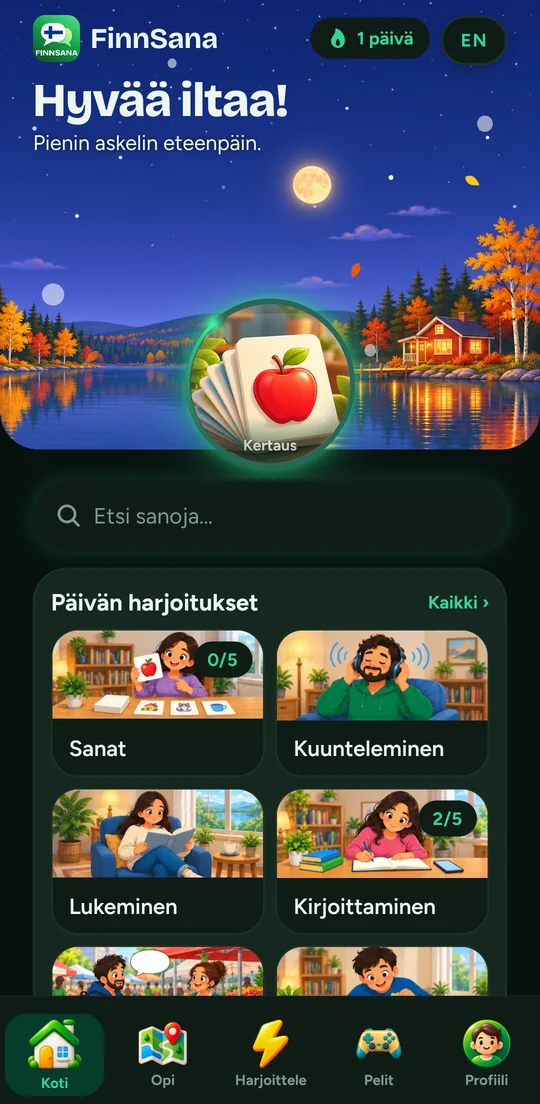
FinnSana is an Android app with a Finnish course from A1 to B2: about 5,000 words with pictures and audio, more than 100 grammar lessons, spoken Finnish next to standard Finnish, and everyday situations such as the doctor and the pharmacy with ready-made phrases. It is free to start, with no ads. For a nursing student, an app works best together with real communication on placement. Our Finnish for healthcare page collects more resources.
How FinnSana helps
FinnSana has everyday situations (shop, doctor, pharmacy, work, transport) with ready-made phrases you can hear and practise. Six situations are free.
See the FinnSana app · Get it on Google Play
Frequently asked questions
Can I work as a nurse in Finland without Finnish?
Most nursing work in Finland involves Finnish-speaking patients and colleagues, so Finnish is usually essential. For official language requirements, check the licensing authority and the employer.
What Finnish should nursing students learn first?
Start with patient questions (pain, help, feeling), vital-sign words and simple reporting sentences, then add spoken Finnish and documentation language.
Should nurses use sinä or te with patients?
Many wards use sinä, but older patients are often addressed with te. Learn both and follow your ward's practice.

 Topic guideFinnish for healthcare workers: phrases and practice
 BeginnerHow to Learn Finnish: A Step-by-Step Plan for Beginners
 NursingFinnish Medication Vocabulary for Nurses
 NursingFinnish Nursing Documentation Phrases (Kirjaaminen)
 Facebook
 Reddit
 LinkedIn
 WhatsApp